Welcome to the Bell, Book and Camera Productions educational materials website. On the pages of this website is the content contained in many of our educational activities. We have webquests and other activities available for use in classrooms.
These activities cover mainly history courses. For a complete listing of activities available, please visit our store at Teachers Pay Teachers.
For more information about us, visit BELLBOOKCAMERA.COM

Human Rights
Human rights are a relatively new concept in world history. It really wasn't until the Enlightenment of the 17th and 18th centuries when the word was defined and used in various documents, such as the Declaration of Independence and the Declaration of the Rights of Man and Citizen.
In 1948, the United Nations adopted the Universal Declaration of Human Rights, which lists 27 rights that all human beings have, which includes freedom of speech, freedom of religion, freedom of movement and more.
A right is simply a standard of behavior and respect that all people have on the basis that they are human beings. These rights are considered to be inalienable--that is, they cannot be taken away by anyone.
One of the very first times that rights were recognized by governments was during the Persian Empire. Cyrus the Great issued a series of laws and recognitions regarding the rights of people within his empire in 539 BCE. These were written down on the Cyrus Cylinder and declared that people have the right to choose their own religion.
Discussions of rights became a big focus of the Enlightenment and led to revolutions against absolute monarchs and the establishment of constitutional democracies.
Today, issues involving human rights are widespread. War and globalization have diminished the protection of human rights in many areas. Human rights tend to be more protected in countries that have established democracies.
Issues involving human rights are complex and varied. Below is a short list of current issues regarding human rights in the world today:
Child labor
Refugees
Political prisoners
Slavery
Gender equality
Reproductive rights
Religious freedom
Internet freedom
Censorship
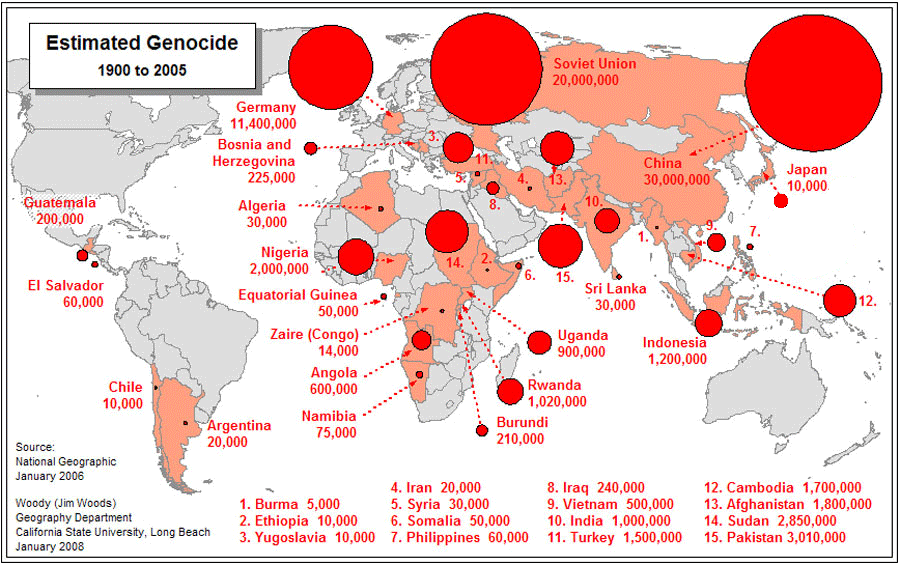
One of the biggest violations of human rights is genocide. The term was created after World War II to give a name to what occurred during the Holocaust. However, genocides--the killing of people based on religion, ethnicity or race-- has occurred throughout history. And continues to occur today.
The map below has several of the genocides of the last 100 years.
Here are some other charts relating to human rights issues:


You will find more infographics at Statista


Freedom on the Net scores are based on a scale of 0 to 100 with 0 representing the best level of freedom on the net progress and 100 the worst. The 2016 ratings reflect the period of June 1, 2015 through May 31, 2016.
In 1948, the United Nations adopted the Universal Declaration of Human Rights, which lists 27 rights that all human beings have, which includes freedom of speech, freedom of religion, freedom of movement and more.
A right is simply a standard of behavior and respect that all people have on the basis that they are human beings. These rights are considered to be inalienable--that is, they cannot be taken away by anyone.
 |
| The Cyrus Cylinder By Prioryman (Own work) [CC BY-SA 3.0 (http://creativecommons.org/licenses/by-sa/3.0) or GFDL (http://www.gnu.org/copyleft/fdl.html)], via Wikimedia Commons |
Discussions of rights became a big focus of the Enlightenment and led to revolutions against absolute monarchs and the establishment of constitutional democracies.
Today, issues involving human rights are widespread. War and globalization have diminished the protection of human rights in many areas. Human rights tend to be more protected in countries that have established democracies.
Issues involving human rights are complex and varied. Below is a short list of current issues regarding human rights in the world today:
Child labor
Refugees
Political prisoners
Slavery
Gender equality
Reproductive rights
Religious freedom
Internet freedom
Censorship
One of the biggest violations of human rights is genocide. The term was created after World War II to give a name to what occurred during the Holocaust. However, genocides--the killing of people based on religion, ethnicity or race-- has occurred throughout history. And continues to occur today.
The map below has several of the genocides of the last 100 years.
 |
| http://web.csulb.edu/president/humanrights/archives/2008/estimated_genocide/ |
Here are some other charts relating to human rights issues:

Globalization
Globalization has been an on-going process since the moment human beings created civilization. Globalization is the the connections human make via trade and the culture that blends and diffuses as a result.
Today, globalization is truly a "global" phenomenon--with entertainment, music, sports, brands and corporations having global influence and recognition.
Globalization began occurring during the ancient world. Wax seals made in the Indus River Valley have been discovered in Mesopotamia, demonstrating that those two civilization had been in contact through trade. Greek culture was spread by Alexander the Great and influenced culture in the Middle East and India.
As religions moved from their places of origin they acquired characteristics of cultures in other parts of the world. For example, Christianity was influenced not only by Judaism but also the ancient Persian religion of Zoroastrianism.
Buddhism, while originating in India, acquired distinctly Chinese features when it moved to China.
Globalization, as a process, became "global" with the Age of Discovery in the 15th century. The opening up of North and South America after Columbus caused a boom in trade and an unprecedented movement of not only people, but plants and animals across the world. Corn, a New World-only crop, soon starting being grown in Europe, Africa and Asia. Horses, unknown at the time in the New World, became the mode of transportation used by Native Americans once the animals were brought by Europeans.
This event was known as "The Columbian Exchange" and it created the modern world. Boats began criss-crossing the hemispheres like never before. People began moving to different locations across the world.

The Columbian Exchange led to a change in food production across the globe. The chili pepper, for example, was first grown by people in Mexico. It is now a main ingredient in food in India, Thailand, South Korea andChina.
The trade in sugar became one of the first global industries. Unfortunately, this fueled another global industry as well: the Trans-Atlantic Slave Trade. As a result, millions of people from Africa were kidnapped and brought to the New World and other places across the globe.
Slavery has not ended, however. In fact, because of globalization there are more slaves in the world today than at any other time in our history.
The Industrial Revolution, which began in England in the late 18th century, further spurred globalization as the need for raw materials drove corporations to gather these materials from other places, often at the point of a gun.
It is no different today. All you need to do is look at the cell phone in your pocket. Ingredients and labor used to make that cell phone has come from all over the globe.

The electronic industry is made up of multinational corporations which have an influence all across the world. Although Samsung, for example, is a corporation located in South Korea, it has offices virtually in every major nation and sources its materials from all over the world.
Soccer is a global sport, although it has it's origins in Europe.
Fast-food, once just a part of American culture, is now recognized all over the world.
Musicians and entertainers have global appeal.
When Hollywood makes movies, they gear the movies not just to American audiences, but for global audiences as well.
Through technology that was created through globalization, the world in which we live today is connected unlike any time before.
Check out the following images related to globalization:
Today, globalization is truly a "global" phenomenon--with entertainment, music, sports, brands and corporations having global influence and recognition.
 |
| Seal from the Indus Valley Civilization Public Domain. |
As religions moved from their places of origin they acquired characteristics of cultures in other parts of the world. For example, Christianity was influenced not only by Judaism but also the ancient Persian religion of Zoroastrianism.
Buddhism, while originating in India, acquired distinctly Chinese features when it moved to China.
Globalization, as a process, became "global" with the Age of Discovery in the 15th century. The opening up of North and South America after Columbus caused a boom in trade and an unprecedented movement of not only people, but plants and animals across the world. Corn, a New World-only crop, soon starting being grown in Europe, Africa and Asia. Horses, unknown at the time in the New World, became the mode of transportation used by Native Americans once the animals were brought by Europeans.
This event was known as "The Columbian Exchange" and it created the modern world. Boats began criss-crossing the hemispheres like never before. People began moving to different locations across the world.

The Columbian Exchange led to a change in food production across the globe. The chili pepper, for example, was first grown by people in Mexico. It is now a main ingredient in food in India, Thailand, South Korea andChina.
The trade in sugar became one of the first global industries. Unfortunately, this fueled another global industry as well: the Trans-Atlantic Slave Trade. As a result, millions of people from Africa were kidnapped and brought to the New World and other places across the globe.
Slavery has not ended, however. In fact, because of globalization there are more slaves in the world today than at any other time in our history.
The Industrial Revolution, which began in England in the late 18th century, further spurred globalization as the need for raw materials drove corporations to gather these materials from other places, often at the point of a gun.
It is no different today. All you need to do is look at the cell phone in your pocket. Ingredients and labor used to make that cell phone has come from all over the globe.

The electronic industry is made up of multinational corporations which have an influence all across the world. Although Samsung, for example, is a corporation located in South Korea, it has offices virtually in every major nation and sources its materials from all over the world.
Soccer is a global sport, although it has it's origins in Europe.
Fast-food, once just a part of American culture, is now recognized all over the world.
Musicians and entertainers have global appeal.
When Hollywood makes movies, they gear the movies not just to American audiences, but for global audiences as well.
Through technology that was created through globalization, the world in which we live today is connected unlike any time before.
Check out the following images related to globalization:
 |
| Source: http://www.indexmundi.com/blog/index.php/2013/02/25/the-presence-of-mcdonalds-across-the-world/ |
 |
| Source: http://www.altenergyshift.com/gallery/image/143-globalization-starbucks-vs-mcdonalds-infographic/ |
The Environment

Two events in the history of the world radically changed the Earth's environment: the Columbian Exchange and the Industrial Revolution.

The Industrial Revolution, starting in Europe in the late 18th century, further changed humanity by introducing machines and factories to human society. This caused many changes, including urbanization (the growth of cities), pollution, and new economic systems. Urbanization, in particular, altered the human landscape as cities grew faster than at any other time. This is a process that continues to this day.

Climate change can lead to more severe weather, desertification, rising sea levels and the spread of disease. Countries have attempted to deal with climate change by signing treaties, such as the Paris Climate Agreement and turning to more environmentally-friendly sources of energy, such as solar.
The modern world has many environmental challenges. These challenges include the use of pesticides, loss of biodiversity, acidification of the oceans and urban pollution.
Take a look at the following charts, highlighting some of these issues.


War and Conflict
 |
| American soldiers in the First World War U.S. Army/Public Domain |
War has not always been a part of the human experience. Prior to the Neolithic Revolution--when human beings learned how to farm some 8,000 years ago--there is little evidence of human beings engaging in large-scale fighting.
Then why did human beings ever become war-prone?
The answer lies in property. When humans began settling down into villages to farm, they started to claim land. Economic systems developed which led to the creation of money and, consequently, in the desire of others to accumulate wealth and power. War became a means to that end.
Fighting and warfare has almost always been tied to the acquisition of land and property, in one way or another.
There are several types of war that have been used throughout history:
Conventional War: This is the most common of all war in which state governments formally announce war against another country or government. At one time it was customary for governments to make announcements prior to going to war. This type of warfare usually does not involve nuclear, biological or chemical weapons.
Total War: This is a type of war that affects all aspects of country and is conducted by any means possible, breaking rules of war and often targeting civilians in the process. World War I and II are prime examples.
Civil War: This is a war within a country when members of a society go to war against each other. In the United States, the American Civil War was fought between the North and the South over issues regarding slavery. Most modern states have experienced civil war in one way or another. Civil Wars are currently raging in South Sudan, Syria, Afghanistan and Iraq.
Guerrilla War: This is a type of war fought by small groups using unconventional tactics, such as sabotage, hit-and-run raids, and use of civilians as soldiers. Usually, guerrilla warfare is used by small groups against larger, more technologically advanced adversaries. The term was first used in the fighting by Spanish insurgents in 1808 against Napoleon's army in Spain. The Vietnam War is also an example of guerrilla warfare.
Cyberwar: This type of warfare involves the use of computers and the internet to attack the computer infrastructure in other countries. In terms of warfare, this is the one type that has increased int he last decade. The spreading of computer viruses and the hacking of computer networks are the principle activities in cyberwarfare. In 2016, hackers in Russia broke into various components of the U.S. election system. To see a map of current cyberattacks, click here.
 Wars can involve the use of weapons that most modern societies prohibit from war. These weapons include chemical agents, such as mustard gas that was used in World War I and sarin, a toxic nerve agent that was used most recently in Syria. Biological weapons are those which intentionally spread disease among populations. The Mongols famously catapulted bodies infected with the bubonic plague over city walls, for example.
Nuclear weapons are the newest type of weapon capable of inflicting mass destruction. Developed first by the United States in World War II, two of these weapons were used on the cities of Hiroshima and Nagasaki in Japan. Today, there are 9 counties that have nuclear weapons.
This graph shows the trend of war from 1945 to 2014:
 |
| Source: Slate Magazine (http://www.slate.com/articles/news_and_politics/foreigners/2014/12/the_world_is_not_falling_apart_the_trend_lines_reveal_an_increasingly_peaceful.html) |
Currently, renewed conflicts in Syria, Afghanistan and central Africa has dominated the news. Warfare is a fact of life in many war-torn areas. Civilians suffer the most as one aspect of modern war remains: civilians are targets. In World War II, more civilians died in war than did soldiers.
Click on the map below for current global conflicts from the Council on Foreign Relations:

Terrorism
 |
| Terrorist Attack of September 11, 2001 |
However, terrorism is not a new phenomenon. It has been around for as long as humans have organized governments.
Terrorism refers to violence--usually against civilians--by a group or government for the purpose of creating fear in order to push a political, religious or social goal.
The term itself was first used during the French Revolution when the revolutionary leader, Maximilien Robespierre, famously stated, "Let terror be the order of the day." During what became known as the "Reign of Terror," the government of France rounded up and killed over 60,000 people thought to be a threat to the revolution.
These acts go back even further. The Assyrians in ancient Mesopotamia used terror as a weapon of war, famously lining the walls of conquered cities with the skins of civilians.
Most terrorism is political in nature. That means that groups use terrorism in order to cause a change in government.
For example, several groups used terrorism in Russia in the 1800s in order to get rid of the Tsar and try to change Russia's government. In 1881, a terrorist group called "The Peoples' Will" successfully assassinated Tsar Alexander II in a bombing in St. Petersburg.
The Irish Republican Brotherhood and later the Irish Republican Army used terrorism against England in an attempt to bring Independence to Ireland and Northern Ireland.
Religion is often used as a justification for terrorism. But, it should be noted, that no religion actually supports terrorism, but groups use religion in order to justify its goals to bring about political change.
Before the creation of Israel, for example, Zionists (those who wanted to reestablish a Jewish state in Palestine) used terrorism to draw attention to this goal. On July 26, 1946, a Jewish group known as Irgun bombed the King David Hotel in Jerusalem, killing over 90 people.
After the creation of Israel, conflicts arose between the Israeli state and the Palestinians with terrorism often the means by which groups such as the Palestinian Liberation Organization (PLO) and Hamas tried to gain control over territory controlled by Israel.
In the Central African Republic, a Christian group calling itself Antibalaka has attacked local Muslim populations in an effort to extract revenge for a bloody coup that occurred in 2013.
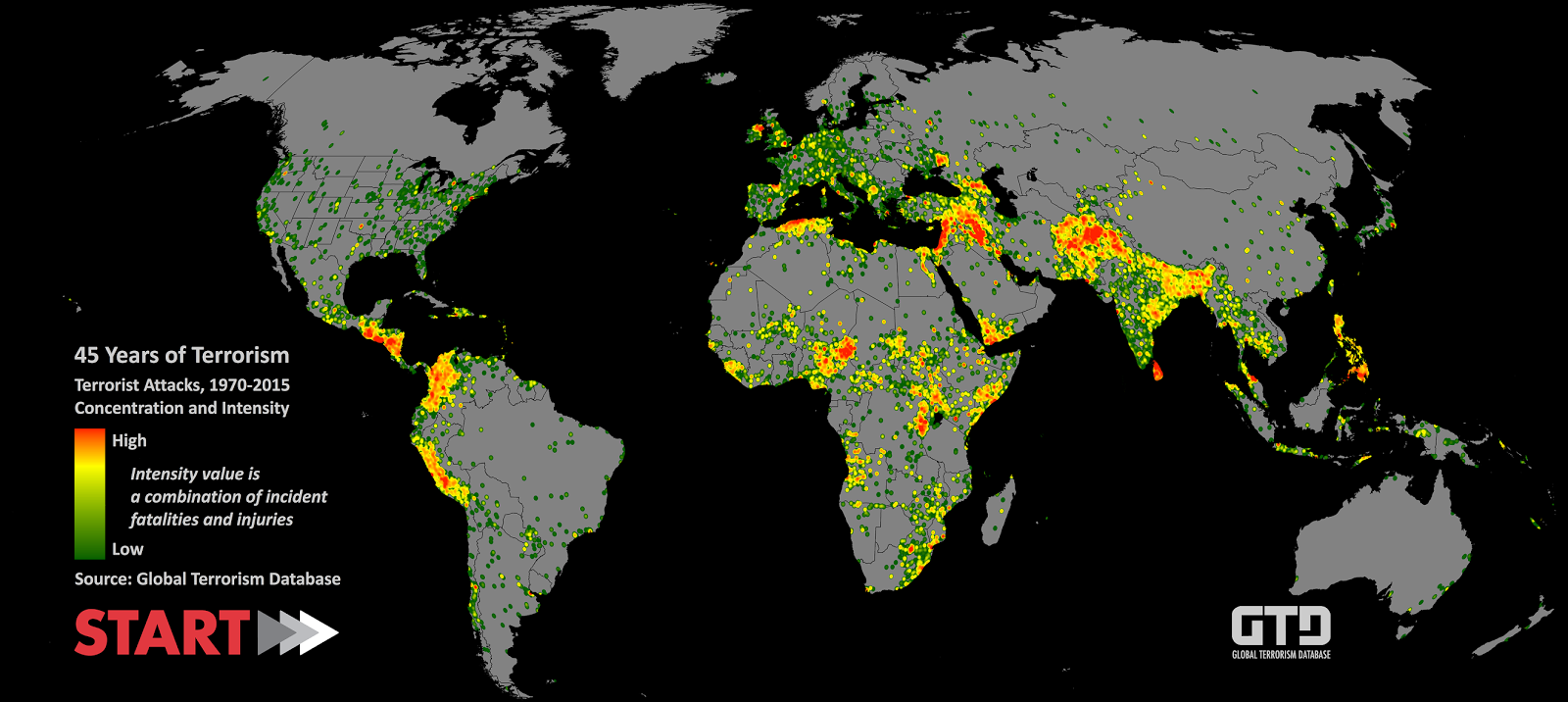
Of course, the most notorious of terrorist organizations is ISIS, or the Islamic State. This group is waging war in various Middle Eastern countries in order to establish a unified government under Islamic law. They have taken responsibility for many terrorist attacks, most notably the Bataclan Massacre in Paris and the Manchester Bombing in England. Often, ISIS uses suicide bombers to carry out their attacks.
Although ISIS attacks are heavily covered by the media in the Western World, it should be noted that most of the terrorist attacks conducted by ISIS occur in Muslim countries where the majority victims are Muslim civilians. ISIS wants to overthrow current governments in the Middle East to establish a Caliphate.
 |
| 45 Years of Terrorism (1970-2015). Courtesy of the the Global Terrorism Database https://www.start.umd.edu/gtd/ |
Many countries have experienced domestic terrorism in which groups use violence for social goals. For example, in the United States, the Ku Klux Klan was established to intimidate African Americans and enforce segregation. In addition, terrorist activities have been conducted by groups wanting to end abortion or stop animal abuse and whaling.
Terrorism can generally be classified into several basic types:
- State-Sponsored terrorism: terrorist acts on a state or government by a state or government.
- Dissent terrorism: terrorist groups which have rebelled against their government.
- Left and Right-winged Terrorism: terrorist groups rooted in political ideology.
- Religious terrorism: terrorist groups which are extremely religiously motivated.
- Criminal Terrorism: terrorists acts used to aid in crime and criminal profit.
- Issue-Oriented Terrorism: terrorist acts to advance a specific issue.
Ancient Empires: Han China
In 206 BCE, the Qin Dynasty in China was overthrown by a new family, led by a man named Liu Bang. They were known as the Han and they established an empire in China that would last for over 400 years. Like Rome in Europe, the Han expanded its borders to create the largest empire in China up until that time.
The Han Dynasty organized itself around the teachings of the philosopher Confucius. In fact, Confucius is arguably one of the most important figures in Chinese history with an influence that can still be felt in China today.
 |
| The extent of the Han Dynasty in China. Public Domain |
Like other societies at the time, Han China had a highly structured society. At the top was the supreme ruler, the emperor. Since the belief in the "Mandate of Heaven" was embedded deep within Chinese culture, most people accepted his rule. The Mandate of Heaven held that a family could rule as long as they had the favor of the gods. Once the family displeased the gods, their rule would be over.
But the emperor was not alone in ruling this large empire. China had an efficient bureaucracy, and the everyday management of the country was left to lesser kings, governors and government officials.
But the emperor was not alone in ruling this large empire. China had an efficient bureaucracy, and the everyday management of the country was left to lesser kings, governors and government officials.
 |
| Confucius |
Confucius taught that everyone had a duty and responsibility to others in society. His philosophy stressed loyalty and tradition. One key element of Confucianism is the idea of filial piety, the respect all must show to members of their family, both living and dead.
Confucius was so important that in order to get a job with the government, you had to take an exam to show how much you know about the teachings of Confucius!
Out of all of the cultures during the classical age, China was the most technologically advanced. During the Han Dynasty, China began adding to a wall begun during the Qin Dynasty in order to protect its northern borders. The wall was a project that continued on and off for the next 1000 years, with dynasties adding to it and enhancing it over the years. In all, the Great Wall of China today stretches for over 5,500 miles.
 |
| This is a section of the Great Wall today. So many people died making the wall, the bodies were buried within the wall. It is often known as the "longest graveyard." (By Georgio (Own work) CC-BY-SA-3.0 (http://creativecommons.org/licenses/by-sa/3.0/)], via Wikimedia Commons |
In addition to the Great Wall, the Han Dynasty also added hundreds of miles to a series of canals throughout northern China, making connections to the vitally important Huang He River. These canals would be further extended by Sui Dynasty, which reunited China after the collapse of the Han. The work done by the Sui would connect all of these canal systems and create what became known as the Grand Canal--the largest canal in the world. The canal extends from Beijing in the north and travels over 1100 miles to Hangzhou, effectively connecting the Huang He and Yangtze rivers.
The Han Dynasty is known for its many important technological innovations and inventions. One of the most important is the invention of paper. In addition, the Han developed the wheelbarrow, cast iron, acupuncture and hot air balloons.
The Han Dynasty was connected through trade to other regions of the world including, for the first time, to Europe. It was the trade of silk that connected China to the rest of the world. Silk was so precious that Chinese rulers made it a crime to give away the secrets of silk making.
Silk lead to the establishment of a trade route between Han China and Rome called the "Silk Road." All sorts of goods traveled the Silk Road. But also other things moved as well. Buddhism from India was spread by merchants along the silk roads and became one of the most important religions in China.
 |
| The Modern Course of the Grand Canal By Ian Kiu (Own work) [GFDL (http://www.gnu.org/copyleft/fdl.html) or CC BY 3.0 (http://creativecommons.org/licenses/by/3.0)], via Wikimedia Commons |
The Han Dynasty is known for its many important technological innovations and inventions. One of the most important is the invention of paper. In addition, the Han developed the wheelbarrow, cast iron, acupuncture and hot air balloons.
The Han Dynasty was connected through trade to other regions of the world including, for the first time, to Europe. It was the trade of silk that connected China to the rest of the world. Silk was so precious that Chinese rulers made it a crime to give away the secrets of silk making.
Silk lead to the establishment of a trade route between Han China and Rome called the "Silk Road." All sorts of goods traveled the Silk Road. But also other things moved as well. Buddhism from India was spread by merchants along the silk roads and became one of the most important religions in China.
 |
| The Silk Road was actually several trade routes that carried all sorts of good over land. The red lines represent the Silk Roads. The blue lines are routes in the Indian Ocean trade. |
Like what was to happen in Rome, the Han experienced some problems near the end of the empire too. They started to be attacked by nomadic invaders from the north. In addition, economic troubles plagued the empire. By 220 CE, the Han Dynasty was in deep decline and would soon be replaced by another empire.
Important Points to Remember:
Important Points to Remember:
- The Han Dynasty expanded China's border's through trade, diplomacy and military power
- Chinese society was organized under the ideas of Confucius, the most famous Chinese philosopher
- Silk was the most important item traded from China
- Han China was known for its many inventions and innovations, most notably the development of paper
Ancient Empires: Rome
When people think of Ancient Rome, they usually thing of decadent emperors living lavish lifestyles. While that image may be somewhat true for a certain period of time, Rome did not start out that way.
Rome was a small city-state located along the Tiber River in what is now modern-day Italy. According to legend, the city was founded by twin brothers, Romulus and Remus. They were abandoned as small children and raised by wolves.
The city was famous for being a republic. A republic is a system of government where the people elect representatives to rule in their names. In fact, most modern democracies trace their origins to the Roman Republic. The United States is a republic and looked to the Roman Senate for inspiration when creating the Constitution.
Building a democratic republic was not easy. Two classes in Roman were bitter rivals. The rich landowners were part of the Patrician class. Everybody else who were not slaves fell into the Plebian class. After years of fighting and struggle, Rome passed a series of laws that gave rights to the Plebians. This law was called the Law of the Twelve Tables and established the concept that everybody should be treated the same when it comes to law. This is called "equality of law" and is the foundation of most law codes in the world today.
As Rome built its republic, it also expanded its borders. After defeating the city-state of Carthage in North Africa in 148 BCE, Rome was the undisputed leader of the Mediterranean region. The Roman Legion was the best fighting force of the era. Generals in the Republic struggled to gain power.
One such general was able to take over Rome and have himself declared a dictator in 46 BCE. His name was Julius Caesar. Although he pretended to abide by the rules of the Republic, he wanted to establish himself as the only power. In 44 BCE, a group of senators stabbed him to death on the floor of the Senate.
Rome fell into civil war. Eventually, a young general (and adopted son of Julius Caesar) named Octavian defeated his rivals and became the sole ruler of Rome. The republic was dead. And now Rome was an Empire.
This man became the first emperor of Rome. His new name was Augustus. He had unlimited power. People saw him as a god.
As the Empire grew, Rome experienced good emperors and bad. The bad emperors we remember. Names like Nero, Caligula and Tiberius still bring to mind corruption and perversity.
The Romans borrowed all of their culture from the ancient Greeks. However, the Romans were great builders. They built huge cities. They cut thousands of miles of roads that were paved and drained. The phrase, "All roads lead to Rome" was a truth of the times. They also invented concrete and the arch.
All over their empire they used this technology to create aqueducts, which are bridge-like structures to bring water down from the mountains. Some of these aqueducts are still working today.
In addition, the Romans also built huge stadiums in order to conduct blood sports known as gladiator games. These stadiums were built using concrete and the arch. The Colosseum in Rome was the most famous. The basic Roman design of these stadiums can be found in modern stadiums all over the world today.
But they also created enemies. Tribal people along the borders of Rome started to attack, weakening Roman Borders. The economy began to suffer through unemployment and inflation. The government suffered from a great amount of corruption and bad leadership, too. Some people within Rome began to rebel against the dominant culture--a culture that demonized the poor and celebrated violence through brutal gladiator games. Poor people, in particular, were drawn to a new religion that came into being in the first century C.E.: Christianity.
Like all empires, Rome would eventually collapse. But nothing truly disappears. From Rome, the Latin language lived on and became the basis for many European languages such as French, Italian and Spanish. Christianity would eventually win out in Rome and spread throughout the world. And Roman law and government forms the basis of much of the modern western world today.
Important Points to Remember:
 |
| Famous bronze statue showing twins Romulus and Remus with the she-wolf who raised them. (Public domain) |
The city was famous for being a republic. A republic is a system of government where the people elect representatives to rule in their names. In fact, most modern democracies trace their origins to the Roman Republic. The United States is a republic and looked to the Roman Senate for inspiration when creating the Constitution.
Building a democratic republic was not easy. Two classes in Roman were bitter rivals. The rich landowners were part of the Patrician class. Everybody else who were not slaves fell into the Plebian class. After years of fighting and struggle, Rome passed a series of laws that gave rights to the Plebians. This law was called the Law of the Twelve Tables and established the concept that everybody should be treated the same when it comes to law. This is called "equality of law" and is the foundation of most law codes in the world today.
 |
| Erecting the Law of the Twelve Table sin the Roman Forum. |
As Rome built its republic, it also expanded its borders. After defeating the city-state of Carthage in North Africa in 148 BCE, Rome was the undisputed leader of the Mediterranean region. The Roman Legion was the best fighting force of the era. Generals in the Republic struggled to gain power.
 |
| The extent of the Roman Republic in 45 BCE. (Public Domain) |
 |
| Julius Caesar (Public Domain) |
One such general was able to take over Rome and have himself declared a dictator in 46 BCE. His name was Julius Caesar. Although he pretended to abide by the rules of the Republic, he wanted to establish himself as the only power. In 44 BCE, a group of senators stabbed him to death on the floor of the Senate.
 |
| The Assassination of Julius Caesar. (Public Domain) |
This man became the first emperor of Rome. His new name was Augustus. He had unlimited power. People saw him as a god.
As the Empire grew, Rome experienced good emperors and bad. The bad emperors we remember. Names like Nero, Caligula and Tiberius still bring to mind corruption and perversity.
 |
| Augustus Caesar, the First Roman Emperor. (Public Domain) |
The Romans borrowed all of their culture from the ancient Greeks. However, the Romans were great builders. They built huge cities. They cut thousands of miles of roads that were paved and drained. The phrase, "All roads lead to Rome" was a truth of the times. They also invented concrete and the arch.
All over their empire they used this technology to create aqueducts, which are bridge-like structures to bring water down from the mountains. Some of these aqueducts are still working today.
 |
| This is the Pont du Gard aqueduct built in around 40 CE. It is located in Southern France. By Benh LIEU SONG (Own work) [CC BY-SA 3.0 (http://creativecommons.org/licenses/by-sa/3.0)], via Wikimedia Commons |
In addition, the Romans also built huge stadiums in order to conduct blood sports known as gladiator games. These stadiums were built using concrete and the arch. The Colosseum in Rome was the most famous. The basic Roman design of these stadiums can be found in modern stadiums all over the world today.
 |
| By Diliff (Photograph by Diliff, edited by Vassil) [CC BY-SA 2.5 (http://creativecommons.org/licenses/by-sa/2.5)], via Wikimedia Commons |
But they also created enemies. Tribal people along the borders of Rome started to attack, weakening Roman Borders. The economy began to suffer through unemployment and inflation. The government suffered from a great amount of corruption and bad leadership, too. Some people within Rome began to rebel against the dominant culture--a culture that demonized the poor and celebrated violence through brutal gladiator games. Poor people, in particular, were drawn to a new religion that came into being in the first century C.E.: Christianity.
 |
| The Roman Empire in 117 CE. By Tataryn (Own work) [CC BY-SA 3.0 (http://creativecommons.org/licenses/by-sa/3.0)], via Wikimedia Commons |
Like all empires, Rome would eventually collapse. But nothing truly disappears. From Rome, the Latin language lived on and became the basis for many European languages such as French, Italian and Spanish. Christianity would eventually win out in Rome and spread throughout the world. And Roman law and government forms the basis of much of the modern western world today.
Important Points to Remember:
- Rome started off first as a Republic, a type of democracy in which people elect representatives
- Although the Romans borrowed much of their culture from Greece, Roman language, law and government has had a lasting impact on the world
- Romans were great builders, creating concrete and arches
- The Roman Empire dominated the western world for over 1000 years
- Christianity would develop during the Roman Empire
Ancient Empires: Persia
By 530 BCE, Persia had become the largest empire in the ancient world. Centered in modern-day Iran, the Persian empire stretched from the Indus River Valley all the way to Egypt in north Africa and just beyond Turkey into the fringes of Europe.

It was Cyrus the Great who made the Persian Empire (also known as the Achaemenid Empire). He ruled from 559-530 B.C.E. Cyrus was different than most rulers at the time. Why? He displayed a level of tolerance for other cultures that went beyond anything displayed by other rulers at the time. He let conquered people keep their languages and traditions, for example.
In 539 BCE, Cyrus captured the city of Babylon in Mesopotamia. There, the Jewish people had been held in captivity for at least 50 years after Jerusalem was captured by the Babylonian king, Nebuchadnezzar. After Cyrus captured the city, he freed the Jews, allowing them to return to Jerusalem. In the Old Testament of the Bible, Cyrus is referred to as the "Messiah," or "Anointed one," and is the only non-Jew to be given that title.
Cyrus the Great died in 530 BCE. Supposedly, he is buried in a tomb located in the ancient city of Pasargadae, in modern Iran. His epitaph once read:
The Royal Road was one of the first major roads built in the ancient world. It was made from stone and connected the new capital of Persia, Persepolis, to the Persian cities in what is now modern-day Turkey. Every 18 miles was a rest house, where riders could get fresh horses. In total, the road stretched for over 1600 miles. Along this road, mail would be sent and it allowed the Persian Empire to stay connected to his vast empire.
Finally, in 331 BCE, the Persian Empire was defeated at the hands of a young man from Macedonia. That man was Alexander the Great.
Important Points to Remember:

It was Cyrus the Great who made the Persian Empire (also known as the Achaemenid Empire). He ruled from 559-530 B.C.E. Cyrus was different than most rulers at the time. Why? He displayed a level of tolerance for other cultures that went beyond anything displayed by other rulers at the time. He let conquered people keep their languages and traditions, for example.
In 539 BCE, Cyrus captured the city of Babylon in Mesopotamia. There, the Jewish people had been held in captivity for at least 50 years after Jerusalem was captured by the Babylonian king, Nebuchadnezzar. After Cyrus captured the city, he freed the Jews, allowing them to return to Jerusalem. In the Old Testament of the Bible, Cyrus is referred to as the "Messiah," or "Anointed one," and is the only non-Jew to be given that title.
 |
| Cyrus the Great's Tomb Creative Commons 3.0 |
O man, whoever you are and wherever you come from, for I know you will come, I am Cyrus who won the Persians their empire. Do not therefore begrudge me this bit of earth that covers my bones.Darius the Great ruled the Persian Empire from 521-486 BCE. He had, during his reign, attempted to invade Greece and failed. His major accomplishments include the creation of the "Royal Road."
The Royal Road was one of the first major roads built in the ancient world. It was made from stone and connected the new capital of Persia, Persepolis, to the Persian cities in what is now modern-day Turkey. Every 18 miles was a rest house, where riders could get fresh horses. In total, the road stretched for over 1600 miles. Along this road, mail would be sent and it allowed the Persian Empire to stay connected to his vast empire.
 |
| The Royal Road Public Domain |
Darius built a new capital for the Persian Empire at Persepolis. This city was huge by ancient standards. The palace was built by workers, not slaves. In fact, Darius continued the tradition established by Cyrus the Great to pay workers for their work. It is said the great hall in his palace could hold 10,000 people.
 |
| Nation's Gate at the ruins of the royal palace at Persepolis. Creative Commons 3.0 |
Important Points to Remember:
- The Persian Empire was the largest empire in the Ancient world before the coming of Rome
- The Persian kings were known for their tolerance of other cultures
- The Royal Road connected the Persian empire and stretched over 1600 miles
Ancient Empires: Greece
But it was not an empire in the traditional sense. Greece was not ruled by one person. But, in terms of culture, Greece created an economic and cultural empire. Through trade and economics, the Greek city-states spread out all through the Mediterranean Sea, creating colonies and trading posts. For hundreds of years, the Greek city-states dominated the region.
 |
| Colonization of the Mediterranean Sea by ancient Greek city-states (public domain) |
 |
| Ancient Greek City-States. (Creative Commons 3.0) |

Ancient Greece was a collection of independent city-states. A city-state in ancient Greece was called a polis. Each city-state was like a small country, each with its own values, culture and government. Some city-states were ruled by kings. Others by wealthy individuals. Although they all shared a common language, they often competed with each other for resources---and some set out to dominate the others. The reason one city-state did not conquer the others is simple: the geography of Greece made that very hard. The Greek peninsula is rocky and mountainous, making travel by land difficult. Thus, creating an empire by conquering territory is a very difficult thing to do in Greece.
For the longest time, one city-state dominated the region: Athens. Through trade and economics, Athens was the richest and most powerful city-state. They had the largest navy and was the cultural center of the Greek world.
 |
| Pericles (Public Domain) |
Athens is where the first known democracy developed. Every Athenian citizen was required to vote and participate in government. From trials to laws, everything was decided by voting. During the "Golden Age" of Athens, a politician named Pericles strengthened the democracy of Greece by increasing the qualification for voting. He also took public funds to build some of Western Civilization's most beautiful buildings, such as the temple to Athena located on the acropolis above the ancient city. This building is called the Parthenon.
 |
| A modern view of the Parthenon on the acropolis above Athens. (Creative Commons 3.0) |

Athens would influence other city-states through their powerful navy. Trade and economic built what is known as the "Athenian Empire." It also caused much resentment among the other city-states.
When the empire of Persia attempted an invasion of Greece in 492 BCE, the Greek world united to defeat Persia during what was called the Persian Wars. However, after that war, the Greek world turned on itself in a bloody civil war that pitted Athens against its arch-rival, Sparta. Sparta was a powerful city-state in Southern Greece, known for its large army.
Sparta was not a democracy. It was a military state where everyone--men and women--sacrificed for the glory of Sparta. All men were required to be in the army and started training at the age of six. Dying in battle was considered the ultimate honor. (Click here to learn the 8 reasons why living in Sparta was not easy)
 |
| The Peloponnesian War (Public Domain) |
A small kingdom to the north of Greece saw an opportunity. And in 338 BCE all of Greece was conquered by King Philip of Macedonia. His son would go on to create an empire of his own.
Important points to remember:
- Ancient Greece is the cradle of Western Civilization. Much of our own culture can be traced there
- Ancient Athens was the birth-place of democracy
- Through economics and trade, the Greek city-states created an empire in the Mediterranean Sea
- The Peloponnesian War left Greece divided and weak, leading to its takeover by Macedonia
Pro-Democracy Movements

That was in the day before the ubiquitousness of cameras and drones and social media, however.
Now, images of pro-democracy protest movements are much more available, making it more difficult for oppressive governments to cover up the their responses to these pro-democracy movements.
A "pro-democracy movement" is a protest by the people against the government for the increased ability to participate in that government. Most pro-democracy movements focus on three things:
1) Increase suffrage 2) Increase the transparency of government (that is, to make public all matters of government) 3) to remove oppressive leaders
Since the Tiananmen Square Massacre, there have been other pro-democracy movements against China. China has a one-party system in which the Chinese Communist Party runs all aspects of government and strictly controls the lives of people in China.

In September of 2019, Hong Kong decided to rescind the extradition bill, but the other demands by the protesters have not been met.
Pro-democracy movements have occurred elsewhere as well:
1) In 2018, protests against Omar al-Bashir, the dictator of Sudan, resulted in his resignation.
2) In 2016, protests in Zimbabwe resulted in the ousting of long-time president Robert Mugabe
3) In a series of protests throughout the Middle East starting in 2010 known as the "Arab Spring," pro-democracy movements resulted in regime changes in Tunisia, Egypt and Libya.
However, the state of democracy in 2019 is somewhat fragile.
 |
| Source: Freedomhouse.org https://freedomhouse.org/report/freedom-world/freedom-world-2018 |
Subscribe to:
Posts (Atom)